Roulette Rules for New Zealand Players: Wheels and Bets
 Available in US
Wheel type determines the pocket layout and zero rules, while bet choices and special rules shape how roulette results are paid.
Table of Contents
- The Wheel Determines Which Roulette Rules Apply
- New Zealand Context: Bonuses and Casino Licensing
- How to Read the Roulette Table and Wheel
- Roulette Odds: What the Zero Changes
- Double-Zero Roulette and the American Wheel
- Inside, Outside and Called Bets: How Table Bets Work
- How a Roulette Spin Resolves
- Minimum Bets: Check the Table Limit Before You Play
- Roulette Payouts and the Effect of Special Rules
- Roulette Strategy: Manage Risk, Not Randomness
The Wheel Determines Which Roulette Rules Apply
Before interpreting a roulette table, identify the wheel used by the game. A wheel’s pocket count and zero arrangement determine which version of the rules applies. Two games can both be called roulette while differing in their number of pockets, the way zero is handled, or the special rules attached to a result. The wheel is therefore the starting point for understanding the game, not just a visual feature.
European Roulette
A European wheel has 37 pockets: one marked zero and 36 numbered pockets. Its single-zero arrangement is the defining feature of this version. When you see a European wheel, you can distinguish it from the American layout by the absence of a double-zero pocket.
The stated house edge for European Roulette is 2.70%. That figure describes the game’s built-in mathematical advantage for the house; it does not predict the result of any individual spin. For identifying the version, the practical point is simpler: European Roulette has one zero, and the wheel has 37 pockets in total.
Understanding roulette rules is a useful first step before choosing where to play. This list gives you a brief reference to the stated licensing and payout information for the operators featured.
License: Tobique Gaming Commission, licence no. 0000064 Neospin is listed with a licence from the Tobique Gaming Commission, licence no. 0000064.
License: Tobique Gaming Commission, licence no. 0000091 7Bit Casino is listed with a licence from the Tobique Gaming Commission, licence no. 0000091.
License: Malta Gaming Authority, licence no. MGA/B2C/370/2017 Play Grand is listed with a Malta Gaming Authority licence, no. MGA/B2C/370/2017.
License: Tobique Gaming Commission, licence no. 0000002 Ricky Casino is listed with a licence from the Tobique Gaming Commission, licence no. 0000002.
License: 07017519840 · Payout speed: 1-3 business days Zotabet lists licence number 07017519840 and a payout speed of 1–3 business days.
License: Malta Gaming Authority, licence no. MGA/B2C/394/2017 N1 Casino is listed with a Malta Gaming Authority licence, no. MGA/B2C/394/2017.
Payout speed: 1-3 business days Lamabet lists a payout speed of 1–3 business days.
Payout speed: 1-3 business days Wintino lists a payout speed of 1–3 business days.
License: Curaçao Gaming Authority, licence no. OGL/2024/165/0185 BitStarz is listed with a Curaçao Gaming Authority licence, no. OGL/2024/165/0185.
Names can be confusing when games are presented in a casino menu. A roulette title may refer to a regional version, while the actual wheel features are what establish the relevant layout. Check the number of pockets and whether the wheel contains one zero or more than one. These visible details provide a firmer basis for identifying the variant than the name alone.
American Roulette
American Roulette has 38 pockets. The wheel includes the numbered pockets, a single zero and a separate double-zero pocket. The extra zero is the key structural difference from the European wheel: it adds another possible pocket without changing the basic idea of a roulette spin.
Its stated house edge is 5.26%. This is higher than the figure given for European Roulette, reflecting the additional pocket in the American layout. The difference is not a separate betting option or a different way of operating the wheel; it follows from the pocket arrangement. If a game is labelled American Roulette, check that its displayed wheel has both zero and double zero.
American Roulette should not be confused with tables that apply a special rule to some bets when a zero appears. Such a rule is not part of the standard American wheel definition. The wheel variant and any extra table rule are separate features: first identify the pockets, then check whether the game specifies an exception.
French Roulette
French Roulette has the same single-zero pocket arrangement as European Roulette: 37 pockets, with one zero. Its distinction lies not in an extra pocket but in special rules that can apply to certain bets when zero lands. La Partage and En Prison are examples of those rules.

This means the wheel alone does not tell you everything about how a French game is treated. Two games may share the same pocket count and zero layout, yet differ in whether the French rules are in force. Look for the rule information attached to the particular game rather than assuming that every single-zero wheel has the same conditions.
La Partage and En Prison are associated with French Roulette, but they do not change the number of pockets. They change what happens to eligible bets after zero. That distinction is useful when comparing game descriptions: pocket layout identifies the wheel, while the listed rules explain whether it has additional treatment for zero.
Mini Roulette
Mini Roulette has 13 pockets, making it a much smaller wheel layout than the European or American versions. Its house edge is stated as 7.89%, decreasing to 3.85% when La Partage applies. The name should not lead you to assume that it is simply a reduced-size version with identical rules; the pocket count and any stated special rule are the details to check.
The contrast among these variants can be summarised by their defining features: European Roulette has 37 pockets and one zero; American Roulette has 38 pockets, including zero and double zero; French Roulette shares the 37-pocket, single-zero arrangement but may add La Partage or En Prison; Mini Roulette has 13 pockets. These are not interchangeable labels. Identifying the wheel first gives you a reliable foundation for reading the game’s specific rules.
European Roulette 37 pockets, single zero
American Roulette 38 pockets, zero and double zero
French Roulette 37 pockets, single zero, special rules
Mini Roulette 13 pockets
New Zealand Context: Bonuses and Casino Licensing
Roulette rules describe how a game works; they do not determine whether a casino may offer it in New Zealand or what conditions attach to a promotion. Those questions sit within the country’s gambling law and the terms set by each operator. In 2026, the legal position is also changing, so the date matters when you assess an online casino’s status.
The Online Casino Gambling Act 2026 came into force on 1 May 2026, establishing New Zealand’s first domestic licensing system for online casino gambling. The transition runs from that date until 1 December 2026. During this period, providers that were already serving people in New Zealand before the Act took effect may continue operating under its transitional provisions. Providers that have not applied for a licence must stop conducting online casino gambling in New Zealand by 1 December 2026. The full licensed regime is not expected to be operational until 2027.
This change follows a different earlier arrangement. The Gambling Act 2003 does not permit online casinos to be based in New Zealand. Before the 2026 Act, gambling websites operating from overseas were not licensed or supervised by a New Zealand regulator. If a customer had a dispute with an offshore site during that period, there was no domestic government recourse. The new licensing framework creates a route for domestic oversight; it does not make every site available to New Zealand residents licensed.
The Department of Internal Affairs oversees the online casino licensing framework and has the lead regulatory role for gambling in New Zealand. The Gambling Commission hears and decides casino licensing applications, issues online casino licences, and approves changes to licence conditions. These functions are related but distinct: the Department provides regulatory oversight, while the Commission makes licensing decisions and considers changes to approved conditions.

The transition also affects how gambling services can be presented to people in New Zealand. Providers are prohibited from advertising online casino gambling services to New Zealand customers during this period. A promotion displayed on a website should not be treated as proof that its operator holds a New Zealand licence or that the promotion is available to every visitor. Eligibility and legal status are separate matters.
Read bonus terms as conditions, not as part of roulette
An operator may attach eligibility rules, wagering requirements, an expiry date, game-contribution rules and withdrawal restrictions to a bonus. These terms determine whether you can claim an offer and what must happen before associated funds or winnings can be withdrawn. They do not change the wheel, the roulette table or the way a spin is settled.
For bonus money, the stated wagering condition is 50X wager within 30 days. Winnings from free spins must be wagered 50X within 7 days. These are separate requirements: the first applies to bonus money, while the second applies to free-spin winnings. Check which balance and which games count toward the requirement, because game contribution can affect how quickly qualifying wagering accumulates. The expiry period also matters; if the stated deadline passes before the requirement is met, the offer may no longer be usable under its terms.
Withdrawal conditions need particular attention. A withdrawal request voids all active or pending bonuses. That means requesting a payout can end a promotion that has not yet been completed, including one that is still pending. Before accepting a bonus, read the complete terms and consider how the wagering requirement, expiry, eligible games and withdrawal rule interact. A headline offer alone does not show the conditions attached to it.
- Read complete bonus terms before accepting
- Check the number of pockets to identify the wheel version
- Treat the wheel as the reference for called bets
- Assume a bonus implies an operator is licensed
- Treat recent results as evidence of future outcomes
- Assume every single-zero wheel uses French rules
The licensing rules and bonus terms answer different questions. Licensing concerns whether a provider is permitted to operate under New Zealand’s framework; bonus terms govern a specific promotion. Neither changes roulette’s game rules, and accepting a bonus does not establish an operator’s licensing status. When you assess a site, keep those issues separate and check the relevant information for the date on which you intend to use it.
How to Read the Roulette Table and Wheel
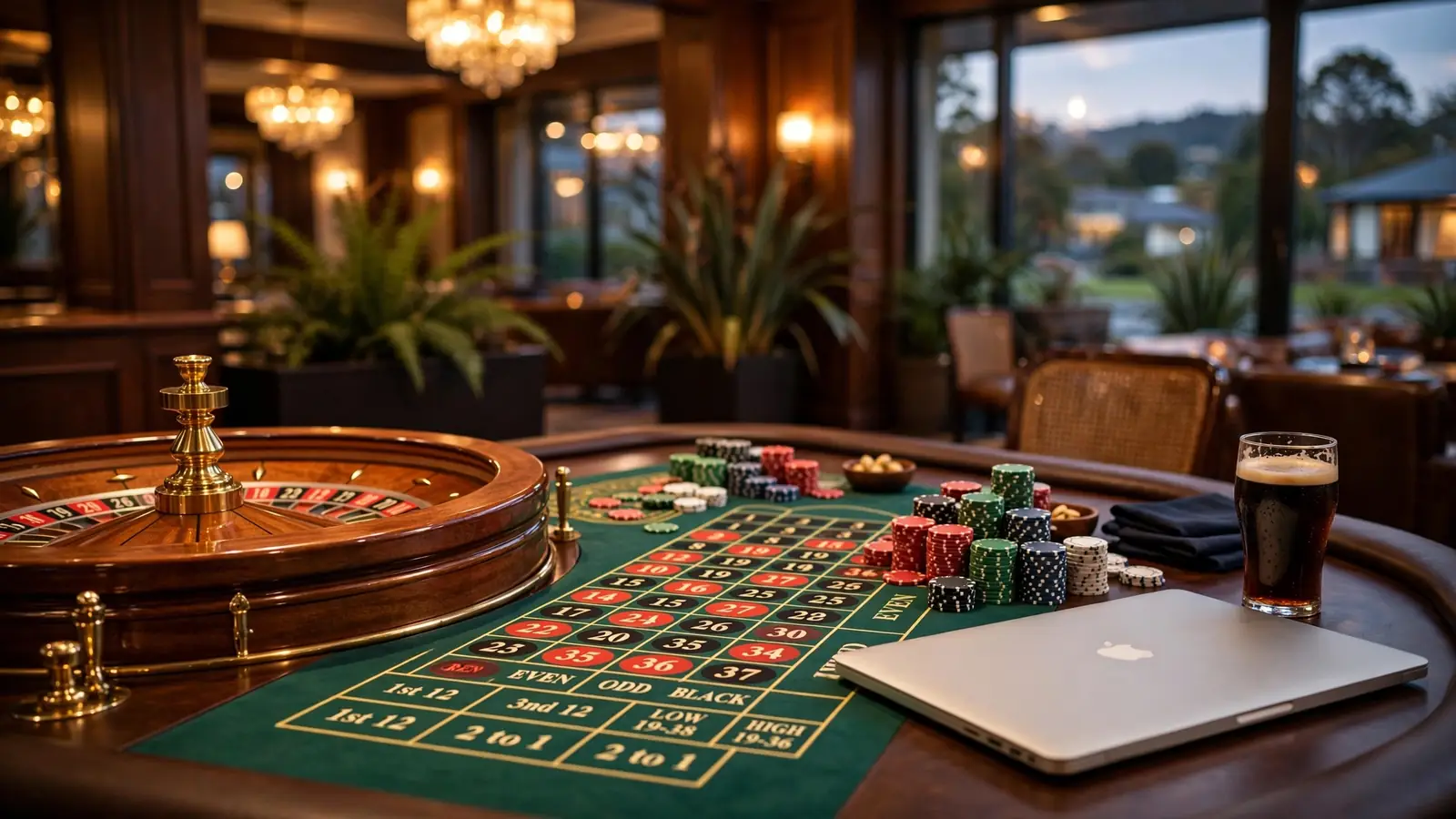
A roulette table presents the numbers in a betting layout, while the wheel holds pockets around its rim. These are two different arrangements of the same numbered outcomes. The table is designed to make number groups easy to identify; the wheel’s sequence determines where pockets sit in relation to one another. A number beside another number on the felt is not necessarily beside it on the wheel.
On the table, the numbered area is usually a rectangular grid. Each number occupies its own space, and the grid’s rows and columns provide a visual way to recognise groups. Around that area, separate sections are marked for broader categories, such as colours or groups of numbers. The zero pocket is shown separately from the main numbered grid because it does not belong to the same layout as the numbered spaces.
The wheel uses a circular arrangement instead. Its pockets are set around the rim, and their order does not follow the table’s rows or columns. That difference matters when a bet or instruction refers to numbers near one another on the wheel. Looking at the felt alone will not tell you which pockets are neighbours: you need to consider the wheel sequence.

Two layouts, two ways of grouping numbers
The table’s grid groups numbers by their position on the felt. It helps you see which spaces form a row, column or marked category. Those visual groupings are features of the betting layout, not a map of the wheel.
The wheel’s arrangement groups numbers by physical position around the rim. A called bet refers to numbers according to their positions on the wheel, not according to where their spaces appear on the table. In other words, a called group is based on wheel neighbours, even if the corresponding numbers look scattered across the felt.
This distinction is useful when you encounter a table label, game instruction or interface control that names a group. First identify whether the group is defined by the table layout or by wheel positions. If it is a called bet, treat the wheel as the reference. Matching numbers by their apparent closeness on the grid would give you the wrong group.
Reading the layout without confusing it with the wheel
Start by recognising the two main visual areas: the numbered grid and the surrounding marked sections. The grid shows individual number spaces and their table-based relationships. The outside sections identify broader groups, rather than changing the order of pockets on the wheel. The position of a mark on the felt tells you where that category appears on the table; it does not indicate where its numbers sit around the wheel.
The table’s grid groups numbers by their position on the felt, whereas the wheel’s arrangement groups numbers by their physical position around the rim.
The wheel is the reference for the order of its pockets. The layout is the reference for where number spaces and categories appear on the table. Keeping those roles separate makes a displayed group easier to interpret, whether you are looking at a physical felt or a digital table.
Online interfaces can rearrange the appearance of controls or highlight selected areas, but the distinction remains: table-based groups come from the layout, while called groups come from wheel positions. A screen that displays a wheel diagram may help you see the latter, but the numbered betting grid does not become a wheel map simply because both show the same outcomes.
This is why reading the roulette table is not just a matter of locating a number. You also need to understand what kind of grouping a label describes. The felt organises spaces for reference; the wheel organises pockets around its rim. Once you keep those two arrangements distinct, a number’s location on the table will not mislead you about its neighbours on the wheel.
Roulette Odds: What the Zero Changes
The number of pockets affects the chance that any particular number wins. A European wheel has 37 pockets: the numbers from 1 to 36 and a single zero. An American wheel has 38, adding a double zero to the same numbered range. If the wheel is fair, each pocket is equally likely on a spin. The extra pocket therefore changes the probability structure for bets tied to the numbered outcomes.

The house edge expresses the casino’s mathematical advantage over repeated play, based on the wheel’s rules. European Roulette has a house edge of 2.70%; on the American wheel, it is 5.26%. The difference comes from the additional pocket: standard winning returns do not rise to compensate for the lower chance of hitting a chosen number. The zero is not an ordinary numbered result for most bets, so it can cause a wager that would win on a numbered pocket to lose instead.
Payout percentage describes the same long-run relationship from the player’s side: it is the expected share of stakes returned over many plays, not a prediction for one session. A specialist review reports a 97.30% payout percentage for European Roulette and 94.70% for American Roulette. These figures correspond to the respective house edges: the gap between the reported return and the full stake is the casino’s mathematical advantage. They do not mean that an individual player will receive that proportion back in a short run. Actual results can vary widely because each spin has a single outcome.
This distinction helps when comparing roulette rules and odds. The pocket count sets the probabilities, while the payout terms determine how much a winning bet returns. Together, they shape the expected return. A wheel with more pockets does not necessarily offer better odds: if the extra pocket makes losing outcomes more likely without a matching increase in winnings, the house edge grows.
A previous result does not alter the next spin. Roulette spins are independent, so a run of zeros does not make a numbered result due, and a long absence of zero does not make zero more likely to appear. The wheel has no memory. Each spin starts with the same set of pockets for that wheel, and the probability of a result is determined by those pockets, not by the sequence that came before it.
Mathematical Reality
Roulette spins are independent events and the wheel has no memory.
That independence also limits what a short record of results can tell you. It can describe what has already happened, but it cannot make the next outcome predictable. When you assess a roulette table, compare the wheel’s pocket count and the rules that determine returns; do not treat recent results as evidence that the probabilities have shifted.
Double-Zero Roulette and the American Wheel
American Roulette has a single zero and a double zero, marked 0 and 00. Together with the numbered pockets, these make 38 pockets on the wheel. The double zero is the practical point to watch: it is an additional possible result, and its presence is part of why the American wheel has a 5.26% house edge.
The basic play is still recognisable as roulette. You select a wager on the table, the wheel is spun, and the result is determined by the pocket where the ball stops. On an American wheel, either 0 or 00 can be that result. Do not treat the double zero as an alternative label for the single zero: it is a separate pocket and a separate outcome.
This distinction matters when you assess what happens to a wager. The standard American rules do not include a general half-stake return simply because a zero has appeared. In particular, you should not assume that an even-money wager receives special protection on either green pocket. The table’s stated rules determine the settlement, so check them before placing a bet rather than inferring a rule from the wheel’s appearance or from another roulette format.

There is a reported exception at some Atlantic City tables. An affiliate review reports that certain American roulette tables there return half the stake on even-money bets when either 0 or 00 lands. Treat that as a table-specific feature reported by that type of source, not as a standard American Roulette rule or a promise about every Atlantic City table. If a particular game offers it, the rule should be stated in that game’s own information. Without that explicit condition, assume the double-zero wheel follows its standard rules.
The distinction is narrow but important: the reported return concerns even-money bets, not every wager on the layout. It also concerns what happens after a zero result, rather than changing which numbers are on the wheel. A rule that returns part of a stake in that situation does not remove the double zero or turn the game into a single-zero version.
When comparing two American roulette games, identify both the wheel and the zero rule. Confirm that the wheel has 0 and 00, then check whether the table explicitly describes a half-stake return for eligible even-money bets. If it does not, do not assume the exception applies. That check separates the standard American format from a table that advertises a special settlement condition, without confusing either one with the ordinary presence of a double zero.
Inside, Outside and Called Bets: How Table Bets Work
A roulette wager begins with a choice of what outcome to cover. At a physical table, you place chips on the marked betting layout; online, you select the corresponding area or bet option. The position of the chip records the selection. It does not change the wheel or the chance that a result will occur.
Inside and Outside Bets
An inside bet covers a number or a small group of numbers marked in the central part of the layout.
An outside bet covers a broader category shown around the number grid, such as a colour, an odd-or-even result, or a range.
Bets marked on the layout
Standard bets are defined by the printed areas on the table. An inside bet covers a number or a small group of numbers marked in the central part of the layout. An outside bet covers a broader category shown around the number grid, such as a colour, an odd-or-even result, or a range. The selected area determines which results count as a win for that wager.
These categories describe how the bet is recorded, not what happens on the spin. A number bet and an outside category bet remain separate wagers even if the number selected also belongs to that category. You can place more than one wager, but each chip or selected amount applies to the specific area where you put it. A chip placed on one selection does not automatically cover a neighbouring number or category.
Before confirming an online wager, check which selection the interface highlights. At a live table, place the chips clearly on the intended marking. If a chip straddles boundaries or the selection is unclear, the table’s procedure determines how the bet is handled. The essential point is to identify the area that records the wager, rather than relying on where the chip appears to sit relative to the wheel.
Called bets follow the wheel
A called bet is specified by reference to a section or sequence of the wheel. The dealer or online game then represents that call through the corresponding number selections on the betting layout. This is different from choosing adjacent cells on the table: numbers next to one another on the layout are not necessarily neighbours on the wheel.

That distinction matters because the table and wheel organise numbers differently. A called bet groups numbers by their physical positions around the rotating wheel, not by their printed positions on the layout. If you use a call, you are asking for a wheel-based grouping to be entered as a set of table wagers. Confirm the call and the displayed selections before the betting period ends, particularly online, where the interface may show the resulting coverage rather than the wheel sequence itself.
When French rules affect a bet
La Partage and En Prison do not apply to every wager. They concern only even-money outside bets, and only when zero lands. An inside bet is not brought under these rules simply because it was placed on the same spin, nor does an outside bet qualify merely because it is outside: it must be an even-money selection.
Under La Partage, half of the stake on an eligible bet is returned and the remaining half is collected. Under En Prison, the wager is held for the next spin; a win returns the original stake without additional winnings, while a loss means the stake is collected. These are French Roulette rules. Treat them as conditions attached to eligible outside wagers, not as a general change to how all table bets work.
How a Roulette Spin Resolves
A roulette round moves through a fixed sequence: bets are placed, betting closes, the wheel is spun, the ball settles into a pocket, and the table settles the wagers. The wheel variant matters because it determines which pockets can produce the result and whether a special rule changes what happens to a bet when zero appears.
Before You Spin
- Identify the wheel’s pocket count and zero arrangement
- Check the table’s minimum bet limit
- Confirm if special rules like La Partage apply
- Verify the bonus wagering requirements if applicable
Before the spin, you choose a permitted bet and place it on the table layout or, for a called bet, ask for the relevant wheel-position group. The dealer accepts bets until betting closes. After that point, you cannot change the wagers for that round. The dealer spins the wheel and sends the ball around it in the opposite direction. When the ball comes to rest in a pocket, that pocket’s number and colour define the result.
The dealer announces the winning number. Bets that cover that result are settled according to the table’s rules; losing wagers are collected, and winning wagers receive their stated return. A zero is a distinct result, not a substitute for a losing number or colour bet. Its effect on a wager depends on the wheel and any special rule offered at that table.
On a French table with La Partage, zero changes the settlement of an eligible even-money outside bet: half the stake is returned, while the other half is collected. With En Prison, that bet is carried into the next spin instead. If the carried bet wins on that spin, you get the original stake back but no additional winnings; if it loses, the stake is collected. These rules apply to even-money outside bets, not to every wager on the layout.
Once the dealer has settled all bets, the round is complete and you can place wagers for the next one. The sequence is the same whether the wheel has a single zero or a different pocket arrangement, but the available outcomes and the treatment of zero can differ. Check which variant and special rules govern the table before betting, so you know how a result will be settled.
Minimum Bets: Check the Table Limit Before You Play
A roulette table’s minimum is a condition on the wager, not a property of the wheel. The wheel determines which pocket can win and which variant’s rules apply. The table limit determines whether the stake you place is accepted. Changing from a single-zero wheel to a double-zero wheel changes the set of possible results; it does not, by itself, tell you the minimum stake.
Before committing chips or confirming a digital wager, read the limit shown for that table. The displayed amount is the threshold you must meet for an accepted bet. If your stake falls below it, the wager may be rejected or require adjustment before the spin proceeds. Do not assume that a limit seen on one table also applies to another, even when both offer the same wheel variant.
The limit can matter at the level of an individual betting position as well as the total amount on the layout. A total stake that appears sufficient may not satisfy a stated minimum for a particular wager. Check the table’s wording so you know what the minimum applies to, and make sure the amount you intend to risk meets that condition before the betting period closes.
This is separate from the payout attached to a winning bet and from rules that govern what happens when zero lands. Meeting a minimum does not improve the chance of winning, change the wheel’s pockets, or remove the house edge. It only establishes whether the wager meets that table’s entry condition.
Attention Only risk money you can afford to lose, as roulette outcomes are random and every real-money bet can lose.
If the stated minimum is more than you are comfortable staking, choose another table or do not place a bet. Do not increase a stake simply to qualify if that would exceed your planned spending. Roulette outcomes are random, and every real-money bet can lose; risk only what you can afford to lose.
Roulette Payouts and the Effect of Special Rules
A roulette payout percentage describes the share of staked money a game is expected to return over repeated play. It is a long-run measure, not a prediction of what you will receive from an individual spin. The house edge expresses the same relationship from the casino’s side: the portion expected to be retained over time.
A specialist roulette review reports payout percentages of 97.30% for European Roulette and 94.70% for American Roulette. These figures reflect the different house edges associated with those wheels. They are not separate promises about a particular table or session; the result of a single wager can differ sharply from the long-run rate.
French Roulette can change the expected return on eligible bets through La Partage or En Prison. Both rules apply only to even-money outside bets when zero lands. With La Partage, half the stake is returned and the remainder is lost. With En Prison, the bet is carried to the next spin: if it wins, you get the original stake back but no additional winnings; if it loses, the stake is collected.
Because these rules limit the loss caused by zero on eligible bets, the French Roulette house edge falls to 1.35% when La Partage or En Prison applies. That reduced edge is specific to those qualifying bets and does not mean every wager on a French table receives the same treatment. Other bet types are not covered by these zero rules.
A specialist roulette review also places 100/1 roulette’s payout percentage within a range from 92.86% to 96.19%. That range should be read as a reported variation, not as a fixed return that applies to every game bearing that label. The table’s stated rules determine how a zero affects a bet, and that affects the expected return.

When comparing roulette payout rules, check both the published return figure and the conditions attached to it. A special rule matters only for the bet types it covers; it does not erase the house edge across the whole game.
Roulette Strategy: Manage Risk, Not Randomness
A roulette strategy can govern how you stake, but it cannot control which pocket receives the ball. Each spin is independent: earlier results do not make a number, colour or side more likely on the next spin. A run of losses is not evidence that a win is due, and a recent result does not provide a signal about what to choose next.
Betting systems that increase or change stakes after wins or losses do not remove the house edge. They change the pattern and size of your exposure, not the wheel’s probabilities. A sequence of outcomes can still go against your bets, and every real-money wager can lose. Do not treat a staking pattern as a way to secure a return.
The wheel and its rules matter more than a betting progression. Single-zero European Roulette has a 2.70% house edge. French Roulette can offer more favourable terms for even-money bets when La Partage or En Prison applies: those rules reduce the disadvantage on eligible bets when zero lands. They do not make a win certain, and they do not change the outcome of any spin. The advantage is specific to those rules and bet types, not a general promise attached to every wager on a French table.
Set a spending limit before you begin and decide when you will stop. Keep gambling money separate from money needed for essentials, and do not chase losses by raising stakes or extending a session. If you reach the limit, stop rather than trying to recover what has already been lost. Only risk money you can afford to lose.
Written by the editors at Casino Bonus Guide NZ.