Online Blackjack in New Zealand: Rules and Play
 Available in US
A practical guide to table rules, hand decisions, payouts, practice games and the differences between standard and live-dealer blackjack.

Table of Contents
- What to Check in an Online Blackjack Table
- New Zealand’s Online Casino Licensing Framework
- How Blackjack Works: Cards, Totals and the Dealer
- Real-Money Play and Blackjack Payouts
- Free Blackjack as a Way to Practise
- How Blackjack Variants and Side Bets Change the Game
- Card Counting in Online Blackjack
- Your Choices During a Blackjack Hand
- Strategy Starts with the Table Rules
- What Changes at a Live-Dealer Blackjack Table
What to Check in an Online Blackjack Table
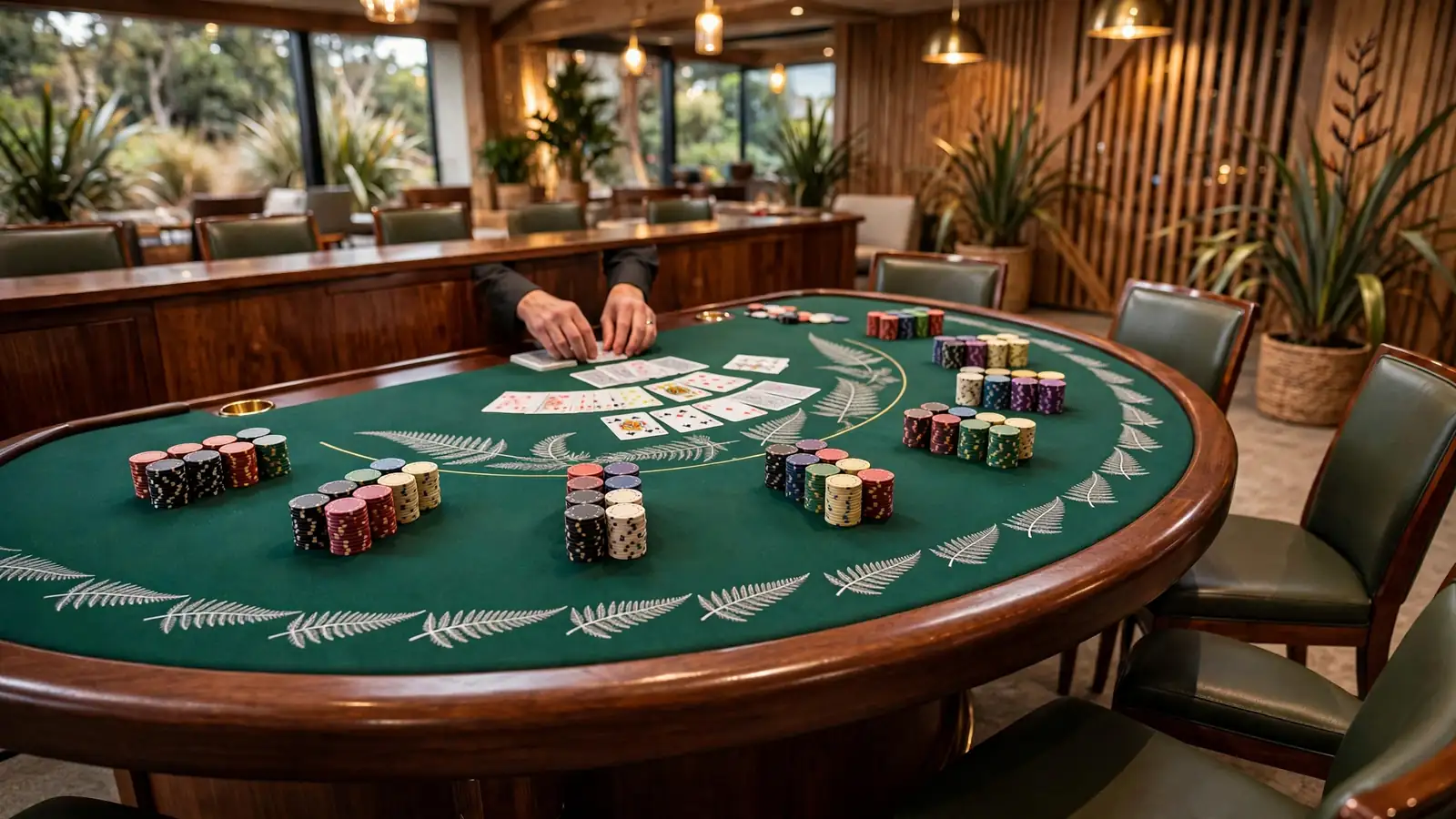
A blackjack table is defined by more than its name or visual design. The rules attached to it determine how cards are dealt, how the dealer completes a hand and what a winning natural blackjack pays. Those details can differ between games, including games offered within the same online casino. Before you sit down, open the table information and check the rules for that specific game rather than relying on a general description of online blackjack.
A specialist review notes that deck count, the dealer’s treatment of soft 17, surrender availability and blackjack payouts can vary from table to table. Treat that as a reason to inspect the displayed rules, not as a basis for assuming what any particular table offers. If a rule is unclear or the information is missing, you cannot reliably compare that table with another.
Deck count
Check how many decks the game uses. This is a basic feature of the dealing setup, but it is easy to overlook when tables have similar names. The deck count matters because it affects the composition of the cards available as play proceeds. A table using a different number of decks is not necessarily a different style of play in every respect, but you should not assume that its other rules match a table you have already tried.
Choosing an online blackjack site in New Zealand can involve checking what information is available about each operator. Use these notes as a starting point, and review the details that matter to you before playing.
License: Tobique Gaming Commission, licence no. 0000064 Neospin lists a licence from the Tobique Gaming Commission, number 0000064.
License: Tobique Gaming Commission, licence no. 0000091 7Bit Casino lists a licence from the Tobique Gaming Commission, number 0000091.
License: Malta Gaming Authority, licence no. MGA/B2C/370/2017 Play Grand lists a Malta Gaming Authority licence, number MGA/B2C/370/2017.
License: Tobique Gaming Commission, licence no. 0000002 Ricky Casino lists a licence from the Tobique Gaming Commission, number 0000002.
License: 07017519840 · Payout speed: 1-3 business days Zotabet lists the identifier 07017519840 and a payout speed of 1–3 business days.
License: Malta Gaming Authority, licence no. MGA/B2C/394/2017 N1 Casino lists a Malta Gaming Authority licence, number MGA/B2C/394/2017.
Payout speed: 1-3 business days Lamabet lists a payout speed of 1–3 business days.
Payout speed: 1-3 business days Wintino lists a payout speed of 1–3 business days.
License: Curaçao Gaming Authority, licence no. OGL/2024/165/0185 BitStarz lists a Curaçao Gaming Authority licence, number OGL/2024/165/0185.
For a useful comparison, record the deck count alongside the other rules rather than judging by the table’s title or appearance. If you compare online blackjack games in New Zealand, keep each game’s rule information separate: details from one table do not establish the rules of another. This is particularly useful when a casino groups several tables under a broad blackjack label.
Dealer action on soft 17
Look for the rule describing what the dealer does on soft 17. A soft hand contains an ace counted as 11 without taking the total over 21; the table rule specifies whether the dealer hits or stands on that total. The difference changes how the dealer completes hands, so it can affect the conditions under which your hand wins, loses or pushes.
Do not infer this rule from a table’s name, graphics or the way another blackjack game behaves. Look for an explicit statement in the rules panel. If the wording is abbreviated, check the table’s help section for an explanation before playing. Knowing this rule helps you compare two otherwise similar tables without treating them as identical.

Surrender rules
Check whether surrender is available and what the table says about its use. It is not a universal feature: rules differ between games. Where it is offered, the timing and conditions matter, so read the table’s explanation rather than assuming that surrender is available in every situation.
This check is separate from learning the basic choices in a hand. Here, the point is to establish whether the particular table includes surrender at all and how its own rules describe it. If you cannot find a clear answer, do not build your expectations around being able to use it.
Blackjack payout
The payout for a natural blackjack is another rule to verify. A natural blackjack is a two-card hand that reaches 21. A specialist review reports that some tables pay 3:2 for this hand, while others pay 6:5. These are different terms, not interchangeable labels: the ratio tells you how the payout relates to the amount wagered on the hand.
Read the payout wording on the table itself. Do not assume that every game labelled blackjack uses the same ratio, and do not treat a payout mentioned in a general casino description as confirmation for a particular table. If the payout is not stated plainly, look for the full rules before choosing to play. This check matters even if two tables share the same deck count and dealer rule.
Deck count Varies by table
Dealer soft 17 Hit or stand
Surrender Available on some tables
Blackjack payout 3:2 or 6:5
Compare the rules as a set
A table’s rules work together. Deck count alone does not tell you how the dealer handles soft 17, whether surrender is allowed or what a natural blackjack pays. Make a short comparison using those fields, and check each entry against the game’s own information. That gives you a concrete basis for comparing blackjack tables without relying on broad claims about which online casino is best.
This approach also helps when you are concerned that an online blackjack game might be rigged. A rule difference is not, by itself, evidence of interference; it may simply be a different table configuration. Focus first on whether the rules are disclosed clearly and whether the game behaves in accordance with them. If the rules are hard to locate, contradictory or too vague to verify, you have less information to judge the table and can choose not to proceed.
For a live table, the same rule checks still matter: the format does not tell you the payout or surrender terms. Keep the table’s rules in view before you begin, and compare like with like. A clear set of stated rules makes it possible to understand what conditions govern the hand; a familiar name or polished interface does not.
New Zealand’s Online Casino Licensing Framework
New Zealand’s online casino rules are changing during 2026. The Online Casino Gambling Act 2026 took effect on 1 May, creating the country’s first domestic licensing system for online casino gambling. The Department of Internal Affairs (DIA) oversees this framework and remains the primary regulator of gambling in New Zealand. The Gambling Commission has a distinct decision-making role: it considers casino licence applications, decides whether to grant them, issues licences and approves changes to licence conditions.

These responsibilities are related but not interchangeable. The DIA oversees how the regulatory framework operates; the Commission makes licensing decisions. A provider’s application is therefore not simply a matter of contacting the department or checking whether a foreign regulator has authorised it. The New Zealand regime establishes a domestic process, with the Commission hearing and determining applications.
The transition to domestic licensing
The new system includes a transition from 1 May 2026 through 1 December 2026. During this period, online casinos that were already serving people in New Zealand before the Act began may continue operating under its transitional provisions. The permission is time-bound: providers that have not applied for a licence must stop offering online casino gambling in New Zealand by 1 December 2026. If an application is refused, the provider must end its New Zealand operations and leave the market.
The full licensed system is expected to be operating in 2027. Until then, it is important to distinguish the new framework from the position that applied before the Act. The Gambling Act 2003 did not permit online casinos to be based in New Zealand, and domestic online casinos were prohibited. Before the 2026 Act, overseas online casino services were not licensed or supervised by a New Zealand regulator. A customer who wagered with an offshore website in that earlier period had no domestic government recourse if a dispute arose.
Licensing Transition
Providers that have not applied for a licence must stop offering online casino gambling in New Zealand by 1 December 2026.
An offshore website may be accessible to people in New Zealand, but access is not the same as domestic licensing or oversight. The change in the law concerns providers and the regulatory framework; a player is not made criminally liable or subject to a fine simply for using an offshore casino. During the transition, advertising online casino gambling to people in New Zealand is prohibited. That restriction should not be confused with the later rules for licensed operators, whose advertising is permitted only under tight conditions; sponsorships are prohibited.
What the regulator roles mean to a player
The licensing system gives the Commission authority to assess applications and set licence conditions, including approving later changes to those conditions. The DIA’s oversight sits at the broader regulatory level. For a player considering online blackjack in New Zealand in 2026, the practical point is that the market is in transition: the existence of a website, or a licence issued overseas, does not by itself show that the provider holds a New Zealand online casino licence.
Licensed operators will have to use stricter age and identity verification systems. These checks are part of the regulatory environment rather than a feature of blackjack itself. The framework also provides for enforcement against providers that operate without a licence. Unlicensed operation is expected to become an offence around mid-2027, and operators may face enforcement action and fines of up to NZ$5 million. Those consequences apply to providers, not to customers merely placing bets.

The Commission’s role remains central as applications are assessed: it determines whether a casino may be licensed and whether licence conditions can be changed. The DIA oversees the wider system in which those decisions take effect. Keeping the two functions separate helps clarify what a licence represents and why the 2026 transition does not mean that every online casino available to New Zealand users is already licensed locally.
How Blackjack Works: Cards, Totals and the Dealer
Blackjack is a contest between your hand and the dealer’s hand. The aim is to finish with a total closer to 21 than the dealer, without going over 21 yourself. You are not trying to match another player’s cards: each player’s result is assessed against the dealer.
A hand total is the sum of the values of its cards. Number cards count as their face values, while each king, queen or jack counts as 10. An ace is flexible: it can count as 1 or 11. That flexibility lets the ace fit the rest of the hand rather than forcing one fixed total.
For instance, an ace with a card worth 7 can total 8 or 18. If the hand later takes a card that makes 18 too high, the ace can count as 1 instead, leaving the hand at a lower total. A hand with an ace counted as 11 is often described as a soft total, because the ace can switch to 1 if needed. When the ace must count as 1 to avoid going over 21, the total is hard.
Ace Flexibility
An ace can count as either 1 or 11, allowing the hand total to adapt to avoid exceeding 21.
This is why adding the printed values alone is not enough when a hand contains an ace. You need to consider both possible values and use the one that keeps the hand within the objective. If no available value prevents the total from exceeding 21, the hand is over 21 and cannot beat a hand that remains within the limit.
The same counting method applies to the dealer’s cards. The dealer’s total is built from the values of the cards in that hand, including the ace’s choice of 1 or 11. Once the dealer’s hand is compared with yours, the totals determine which is closer to 21 without exceeding it. A higher total is not automatically better: a hand that goes over 21 fails the objective, even if its total would otherwise be closer.
In an online blackjack game, the table display shows the cards and commonly presents a running total. Treat that display as a calculation aid, not as a different scoring system. If an ace is present, check whether its value has been counted as 1 or 11 and whether the alternative would change the total. This makes it easier to understand why a displayed total can change when another card is added.
The objective stays the same whether you are looking at a mobile screen or a larger display: compare your hand with the dealer’s, using the card values and the ace’s flexibility. Keeping that foundation clear helps you read the result of a hand without confusing a high total with a winning one. The details of what you can do with a hand depend on the game, but the underlying arithmetic does not: cards contribute their assigned values, the ace can adapt, and the comparison is made against the dealer’s total.
Real-Money Play and Blackjack Payouts
When you wager real money, the payout terms determine how a winning hand changes your balance. A natural blackjack is a two-card hand that qualifies for the table’s blackjack payout. A specialist review reports a 3:2 payout at one table and a 6:5 payout at another; these are examples, not a guarantee of what any particular game offers. Check the rules displayed for the specific table before placing a stake.
The ratio describes the winnings relative to your original stake, not the total amount returned. A 3:2 payout awards winnings at a higher rate than a 6:5 payout for the same stake. The difference applies to a qualifying natural blackjack; it does not mean that every winning hand is paid at that rate. Ordinary wins and special hand outcomes may have separate terms, so read the payout information rather than assuming that one ratio covers the whole game.
Also check what the game counts as a natural blackjack and how the table handles a tie. The payout label alone does not tell you every condition attached to a result. If a rule is unclear in the game display, do not infer it from another table or from a general description of blackjack. The displayed terms for the game you are about to play are the relevant ones.
Before You Stake
- Confirm the stake controls
- Review the payout rules for the specific table
- Check any applicable bonus wagering requirements
- Identify the maximum-bet rule during wagering
Check the terms before you stake
Before wagering, confirm the stake controls and the payout rules, then review any bonus conditions that may apply to your account. A promotion can have wagering requirements: these specify how play relates to the bonus terms. Blackjack may contribute differently from other games towards those requirements, so do not assume that every hand counts equally. Check the stated contribution and whether the promotion applies to the game you plan to play.
Pay particular attention to the maximum-bet rule during wagering. A bonus may set a limit on the size of a permitted bet while its requirements are active. Exceeding that limit can affect eligibility under the bonus conditions. Read the rule before you start, not after a session, and check whether it applies to each hand or to the overall play described in the terms.
Keep the cash balance and any bonus balance distinct in your understanding. The conditions can determine which balance is used and what must happen before bonus funds or related winnings can be withdrawn. Do not treat a displayed bonus as cash you can immediately take out. If the terms do not clearly explain how blackjack play is counted, consider that uncertainty before accepting the offer.
Set a budget for the session and stop when you reach it. A payout ratio describes a rule for a particular result; it does not predict whether you will win or make real-money
Free Blackjack as a Way to Practise
A free game gives you a way to learn the pace and layout of blackjack without staking money. You can follow a hand from deal to result, see how the controls respond and become familiar with the table interface. Because nothing is at stake, you can pause to work out what is happening instead of making a decision under pressure.
Software-based games are useful for repeated practice. Online RNG blackjack uses software shuffles, and hands can be dealt more quickly than at a live-dealer table. That makes it easier to play through many hands in a short session and notice how the game responds to your choices. The trade-off is that the pace may leave less time to think unless you deliberately slow down.
Treat a free session as a test of understanding, not as proof that you can predict outcomes. A run of favourable or unfavourable hands does not establish what will happen next. Practice is most useful when you focus on a process: follow each hand, identify the available controls, and check that you understand how your decision changes the sequence. Avoid judging your progress only by whether a session ends with a positive result.
A live-dealer table works differently because it uses physical cards rather than a software shuffle. The deal is presented through a video stream, so the experience depends on both the table and the connection. Free software play can help you learn the interface, but it does not reproduce the timing or presentation of a live table.
- Use free games to learn the interface and pace
- Focus on understanding the available controls
- Observe how the game responds to your choices
- Use free play to predict future outcomes
- Assume a short session proves game fairness
- Click through hands automatically without thinking
What free play can and cannot show
A free online blackjack game can show you how its interface works and let you practise making decisions without risking funds. It can also help you identify whether the pace, display and controls are clear to you. Those are practical things you can assess directly while playing.
It cannot, by itself, establish whether a game is fair or rigged. Seeing software deal cards is not enough to verify how its random outcomes are generated, and a short session cannot demonstrate what results the game will produce over time. If you are assessing a particular game, distinguish what you can observe in play from claims about its underlying software. A displayed return figure, if one is provided, is not a prediction of the result of your practice session.
Use practice with a specific learning goal rather than treating it as a rehearsal for guaranteed success. You might focus on recognising the available decisions or becoming comfortable with the order in which the interface presents a hand. Keep the session deliberate: when a choice appears, consider what you intend to do before selecting it. This helps you notice whether you understand the game flow, instead of clicking through hands automatically.
Free play is also suitable for blackjack online for fun, provided you understand that the session has no money at stake. The result can still feel engaging, but it should not be confused with a measure of skill or evidence about future outcomes. When you want to learn, repeat the parts that are unclear and use the game to observe how the interface behaves. When you simply want entertainment, treat each hand as an isolated game rather than a signal that the next one is due to go a certain way.
How Blackjack Variants and Side Bets Change the Game
A blackjack variant is not just a different visual design. It is a version of the game with its own combination of rules, and that combination can change which decisions are sensible and how much of an advantage the house has. Two online blackjack tables can therefore look similar while producing different strategic conditions.
When comparing variants, treat each game’s rules as a connected system. A change to one rule may affect how often a hand develops in a particular way; another may alter the consequences of a decision. The overall effect depends on the rules together, not on a label such as “classic” or “premium”. Those labels do not, by themselves, tell you how the game behaves.
This matters when you move between tables or use an online blackjack simulator to examine a game. A strategy applied in one version may not transfer exactly to another. Before relying on a familiar approach, check that the simulator or table reflects the variant you intend to play. If the rules differ, the model you tested may no longer represent the decisions or outcomes at the table.
Blackjack Variants
Different versions of blackjack come with their own combinations of rules, which can alter the house edge and strategic decisions.
Side bets need a separate assessment from the main hand. They are optional wagers attached to particular events or card combinations, rather than part of the ordinary contest against the dealer. Their outcomes and conditions do not necessarily follow the same logic as the main game. A promising-looking side bet should not be treated as evidence that the main blackjack rules are favourable, nor should a strong main game automatically make its side bets worthwhile.
Insurance is one side bet to approach cautiously. It concerns the dealer’s potential blackjack, but it is still a separate wager with its own cost and outcome. For most players, it is better not to use insurance as a routine bet. Consider it independently rather than allowing the name or timing of the offer to make it seem like a protective feature of the hand.
For any side bet, identify what event triggers a win, what the bet pays, and whether its result is separate from the main hand. If those terms are not clear, you cannot compare its risk with the blackjack game itself. A table can offer several side bets without any of them improving the underlying game for you.
The useful comparison is therefore not simply between online blackjack sites or table themes. Separate the main game’s rules from optional wagers, then assess each on its own terms. Variants can alter strategy and house edge; side bets add another set of conditions that should not be assumed to share the main hand’s value.
Card Counting in Online Blackjack
Card counting is a way of keeping track of which cards have appeared, then using that information to estimate what may remain. Its relevance depends on whether cards dealt earlier can affect the composition of cards available later. That distinction matters when you assess card counting in online blackjack: the method does not operate independently of how the game handles its cards.
In New Zealand, using mental calculation to count cards is not illegal. That legal point is separate from whether counting gives you useful information in a particular game. It does not mean that every online format preserves a count, or that a count can reliably predict the next cards.
In a software-based blackjack game, a random number generator determines the cards, and the game uses software shuffles. The faster pace can also mean that hands are dealt more quickly than at a live-dealer table. If the software shuffles between hands, cards from an earlier hand do not provide a dependable record of what can appear in the next one. In that setup, keeping a running count does not reveal a persistent deck composition.
Some games use automatic shuffling processes, which also limit the usefulness of tracking cards across hands. The key issue is not whether you can remember the cards you have seen; it is whether those cards remain relevant to the cards that can be dealt next. If a shuffle resets that relationship, the count loses its practical basis.
A live-dealer game uses physical cards, but that alone does not establish that counting will help. You would need to know how cards are handled between rounds and whether the dealt cards affect the remaining supply. Do not treat the visible cards as proof that a count is actionable. The dealing and shuffling procedure determines whether information carries forward.
Card Counting
Attention In software-based games with automatic shuffling, a running count may not provide a dependable record of future cards.
Claims that card counting works in every online blackjack game overlook this difference between formats. Mental arithmetic may be possible, but the game’s card process controls whether the result means anything. A software shuffle, or an automatic shuffle that breaks continuity, prevents a count from serving as a reliable guide to future cards.
When a game describes itself as random or uses software shuffles, assess the format on those terms rather than assuming a traditional casino shoe is being dealt. Card counting is not a shortcut around the game’s mechanics: its value depends on information about cards already dealt remaining connected to the cards still in play.
Your Choices During a Blackjack Hand
Once the dealer has dealt your hand, you choose whether to take another card or keep the cards you have. The available actions determine how your hand changes; they do not guarantee a particular result. In online blackjack, the game interface presents the choices permitted at that point in the hand.
Hit or stand
Choose hit when you want another card added to your hand. This may bring your total closer to the target, but it can also take you over it. Each hit is a fresh decision: after the card appears, you can assess the new hand and choose again if the game still offers that option.
Choose stand when you want to keep your current hand and take no more cards. Your decision passes control back to the dealer’s sequence of play. Standing can make sense when another card would put your hand at risk, but the result still depends on how the dealer’s hand develops.
Double down or split
With double down, you increase your commitment to the hand and receive another card. This is a more restricted choice than hitting: it trades the possibility of taking further cards for a single additional card. The exact conditions for doubling can differ by table, so check which situations allow the option before relying on it.
Split applies when the starting hand contains a pair. Instead of playing those cards together as one hand, you separate them into two hands and play each in turn. Splitting therefore creates two outcomes to manage, and the table’s rules determine whether the action is available for that pair. The option shown in the game is the practical guide to what you can do at that moment.
Surrender, if offered
Some tables also allow surrender. This lets you withdraw from the hand under the conditions set by that table, rather than continue playing it. It is not available everywhere, and its timing and treatment are rule-dependent. If the option is absent, you cannot assume you may use it.
When playing online, pause to read the action labels before selecting one. A button commits you to a specific change in the hand: another card, no more cards, a doubled commitment, or separate hands. In a multiplayer game, other players’ choices do not replace yours; each hand is handled according to its own available actions.
Strategy Foundation
- Match your strategy to the specific rules of the table
- Treat strategy as conditional advice rather than a universal script
- Avoid betting systems designed to recover losses
- Always set and stick to a session budget
Strategy Starts with the Table Rules
A blackjack strategy is not a set of instructions that works identically at every table. The rules define how hands are resolved and what choices are available, so a change in the rules can alter which decision is strongest and how the house edge is affected. A strategy separated from its table conditions may therefore recommend a move that is not appropriate for the game you are playing.
Before relying on a strategy guide, match its assumptions to the table. Check the rules displayed for that game, including the dealer’s soft-hand procedure, surrender availability, deck setup and blackjack payout. These details are not just fine print: they form part of the mathematical conditions behind a strategy. If a guide assumes different conditions, its recommendations may not transfer directly. Treat a strategy as conditional advice, not as a universal script.
Advanced online blackjack strategy still begins with this comparison. The useful question is not whether a move is described as “optimal” in isolation, but whether it is optimal under the rules and hand situation that apply at your table. When you switch to another variant, review the strategy again rather than assuming that familiar gameplay means identical decisions. Rule differences can affect both the choices available and the house edge.
Betting systems do not change the rules of blackjack or guarantee a winning result. Changing stake sizes cannot make an unfavourable game favourable, and a short run of wins does not establish that a system will keep working. Avoid increasing bets to recover losses. Set a budget before you play, decide when you will stop, and do not chase money already lost.
A sound approach is therefore to choose a strategy that corresponds to the table’s rules, follow it consistently, and keep your spending limits separate from decisions about individual hands. Strategy can help you make decisions in a defined game; it cannot remove the uncertainty of the outcome or promise a profit.
What Changes at a Live-Dealer Blackjack Table
Live-dealer blackjack uses physical cards handled at a casino table, with the game shown to you through a video stream. That gives you a view of a real dealing process rather than an outcome generated and displayed entirely by blackjack software. The central difference is how the game reaches your screen: a live table depends on both the dealer’s actions and the stream, while software-based games use software shuffles and allow faster play.
The stream adds a practical trade-off. Video can arrive with a delay, so what you see may not feel as immediate as a software game. A pause can also make the pace less predictable: the table must proceed through a live dealing process, and the stream has to carry it to you. If you prefer rapid rounds, software blackjack may suit that preference better. If seeing actual cards dealt matters more to you, the live format provides that element.
Betting conditions can differ too. A live table may require higher bets than a software-based game, so check the table’s terms before joining rather than assuming the formats have the same entry conditions. This matters even if the game itself looks familiar: the experience is shaped not only by the cards, but also by the pace and the stakes the table requires.
When assessing online live blackjack, consider whether you are comfortable with a streamed game and its possible delay, and whether the table’s bet conditions fit your intended play. Neither format is simply a faster or more authentic version in every respect. Software play prioritises speed; a live table brings physical cards and a streamed casino-table experience, with possible waits and higher betting requirements as practical costs.
Is card counting illegal?
No. Counting cards using mental calculation is not illegal under New Zealand law.
Does blackjack always pay 3:2?
No. A natural blackjack often pays 3:2, but some tables pay 6:5. Check the payout rules for the specific table.
When will New Zealand launch online casino licenses?
New Zealand’s domestic online casino licensing system took effect on 1 May 2026.
Written by the editors at Casino Bonus Guide NZ.